
Shoulder & rotator cuff physical therapy
In-Home Physical Therapy for Shoulder Pain & Rotator Cuff Injuries
One-on-one care from a Doctor of Physical Therapy for rotator cuff pain, tendinitis, and tears, and the stiffness and weakness that make reaching overhead or sleeping on your side hard—at home, at work, or in another private setting.
Prefer to talk? Call or text (574) 686-7313 (South Bend & Michiana) or (239) 399-5023 (Naples & Southwest Florida).
Serving South Bend & Michiana, Southwest Michigan, and Naples & Southwest Florida. Private-pay physical therapy.

Rotator cuff care
Much of Shoulder Pain Comes Back to the Rotator Cuff
The rotator cuff is a group of four muscles and their tendons that keep the ball of your upper arm centered in the socket as you lift and reach. When those tendons are irritated, worn, or torn, reaching overhead, behind your back, or out to the side can hurt. According to the American Academy of Orthopaedic Surgeons, most rotator cuff tears come from normal wear and tear with age, and people over 40 are at greater risk.
Find What Is Driving Your Pain
Your evaluation looks at your shoulder, shoulder blade, neck, and upper back, how strong the rotator cuff is in each direction, and which movements bring on your pain.
Care Where Your Shoulder Gets Used
We see how you reach into cabinets, lift, get dressed, sleep, and work at your desk—in your own space—so your plan fits your real day.
No Driving or Waiting Rooms
When steering, carrying a bag, or sleeping on your side hurts, your Doctor of Physical Therapy comes to you: at home, at work, or in another private setting.
What we treat
Shoulder Problems We Commonly Treat
You don't need a diagnosis before contacting us. Your evaluation helps determine whether physical therapy is appropriate and what may be contributing.
Rotator Cuff Pain & Tendinitis
- Pain reaching overhead or out to the side
- An ache on the outside of the upper arm
- Pain lying on that shoulder at night
- Weakness lifting, carrying, or reaching behind you
Rotator Cuff Tears
- Partial and full-thickness tears treated without surgery
- A tear found on an MRI or ultrasound
- Shoulder weakness after a fall or a heavy lift
- Before or after surgery: post-surgical rehab
Pain With Reaching & Lifting
- A pinching pain as you raise your arm (often called impingement)
- Shoulder bursitis
- Shoulder pain from golf, tennis, pickleball, swimming, or the gym
- Shoulder blade and posture-related pain
Stiff & Frozen Shoulder
- A shoulder that has gradually lost motion
- Trouble reaching behind your back or fastening a seatbelt
- Frozen shoulder (adhesive capsulitis)
- Stiffness after a period of not using the arm
When to get medical care first
Physical therapy is a good starting point for most shoulder pain. Get prompt medical care instead if your shoulder looks deformed or you can't move your arm after a fall, if you suddenly can't lift your arm after an injury, or if the joint is hot, red, and swollen or you have a fever. Call 911 for shoulder or arm pain that comes with chest pressure, shortness of breath, sweating, or nausea.
Your first visit
What to Expect From Your Shoulder Evaluation
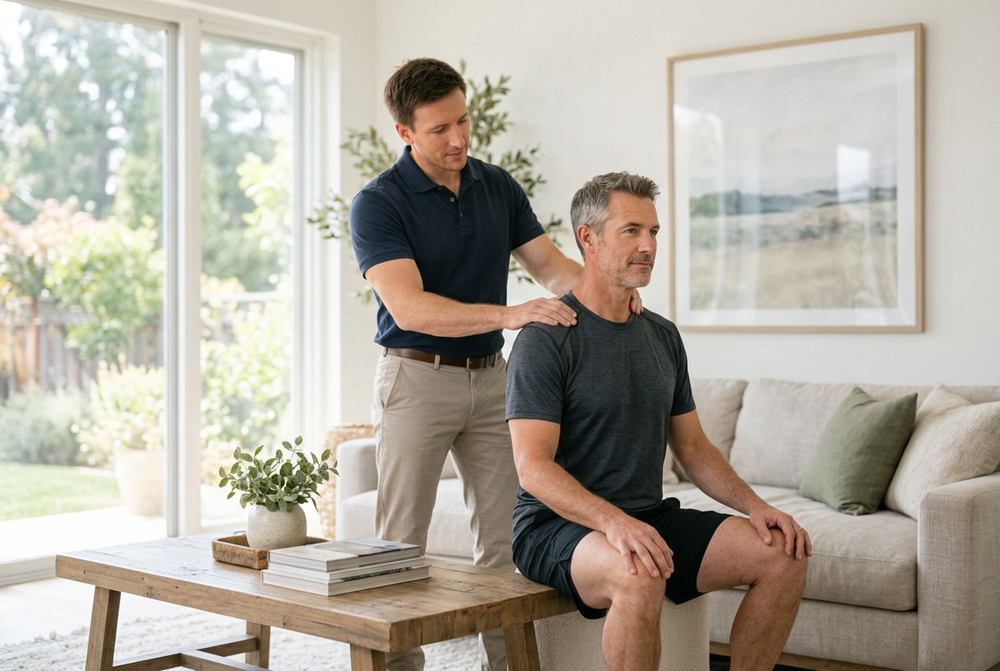
Your first visit is a 60-minute, one-on-one evaluation and treatment session with a Doctor of Physical Therapy. Your therapist brings a treatment table and the supplies the visit needs. Before it ends, you'll understand what we found, what we recommend, and what to do next.
- Your full story. When the pain started, whether there was a fall or a lift, what makes it better or worse, and how it affects sleep, work, and reaching.
- A focused shoulder exam. Range of motion, rotator cuff strength in each direction, how your shoulder blade moves, and a check of your neck, since neck problems can send pain into the shoulder and arm.
- Treatment starts with what we find. When appropriate, care begins the same visit, and you leave with a plan for between visits.
- If something needs a physician's evaluation or imaging, we'll explain why and help guide you to the right next step.
Have X-ray, ultrasound, or MRI reports, notes from your doctor or surgeon, and your health history handy if you have them.
Treatment
Treatment Built Around What We Find
Your plan is chosen from your examination and your goals, and it changes as you respond.
Rotator Cuff Strengthening
Progressive strengthening for the rotator cuff and shoulder blade muscles, matched to what your shoulder tolerates and built up as it improves.
Hands-On Care
Joint and soft-tissue techniques for the shoulder, shoulder blade, neck, and upper back when appropriate.
Dry Needling, Included
Used when clinically appropriate as one part of your plan, with no separate fee. Currently offered in South Bend & Michiana and Southwest Michigan.
Getting Your Reach Back
Restoring motion overhead, behind your back, and out to the side, at a pace your shoulder tolerates.
Everyday Mechanics
Reaching, lifting, carrying, sleeping positions, and desk setup, practiced in the space where you actually do them.
A Home Plan You'll Use
A short routine that fits your day and is updated as you progress.
Cupping, Also Included
Static and dynamic cupping for tight, restricted tissue around the shoulder, shoulder blade, and upper back, used when clinically appropriate as one part of your plan, with no separate fee. More about cupping →
Some people improve in a few visits; others need a longer plan. Your recommendations are based on your findings and how you respond—not on a set number of visits. If you're preparing for or recovering from rotator cuff repair or shoulder replacement, see post-surgical rehabilitation.
The goal
Back to Reaching, Lifting & Sleeping Comfortably
Your plan is built around the activities that matter to you, such as:
- Reaching a high shelf or into the back seat without wincing
- Sleeping through the night, on either side
- Getting dressed, washing your hair, and fastening a seatbelt without pain
- Getting back to golf, tennis, pickleball, swimming, or the gym

“Dr. Elliott exemplifies clinical expertise, effective communication and genuine caring, a rare combination in health care today. I have received excellent physical therapy, including dry needling and cupping for recovery from rotator cuff surgery. … It is wonderfully convenient to have this done in the comfort of my home, and he is always prompt and also flexible with his schedule. I have progressed steadily under his care…”
“He’s helped me with my shoulder as well as my neck and low back pain. For the first time in several years I’m pain free and feel strong again. … Matt took the time to actually listen to my complaints and gave me a very thorough assessment for each area I had problems with. He identified all my problems and addressed each one of them.”
Payment
Private Pay, Explained Up Front
ECPT is a private-pay practice, and payment is due at the time of service. We'll go over cost with you before your first visit, so there are no surprises.
Commercial Insurance
We provide an itemized invoice (often called a superbill) for patients with commercial insurance who wish to seek reimbursement through out-of-network benefits.
Medicare
ECPT is a private-pay practice and does not bill Medicare.
HSA and FSA
HSA and FSA cards can't be used for ECPT visits.
Questions
Questions About Shoulder Physical Therapy
Do I need an MRI before starting physical therapy?
Usually not. Many people with shoulder pain can start physical therapy without imaging. If your exam suggests a significant tear, an injury that needs a physician's evaluation, or a problem coming from somewhere other than the shoulder, we'll explain why and help you take the next step. If you already have reports, have them handy for your first visit.
Does a rotator cuff tear always need surgery?
No. Many rotator cuff tears are treated without surgery. The American Academy of Orthopaedic Surgeons reports that nonsurgical treatment relieves pain and improves function in about 80 to 85% of patients, and strengthening the muscles that support the shoulder is a core part of that treatment. Surgery may be recommended for some tears, such as a tear from a recent injury or pain that doesn't improve. That decision is yours and your surgeon's, and we're glad to work alongside them.
Can you help with frozen shoulder?
Yes. Frozen shoulder usually improves with time, but it can take many months. Physical therapy works on restoring motion at a pace your shoulder tolerates and keeping you as comfortable and functional as possible along the way. If injections or other treatment are part of your care, we coordinate with your physician.
Is dry needling included?
Yes. When it's clinically appropriate, dry needling is part of your visit, with no separate fee. It's one tool within your plan, not a standalone treatment. Dry needling is currently offered in South Bend & Michiana and Southwest Michigan.
How long are visits?
Your first visit is a full 60 minutes, one-on-one with a Doctor of Physical Therapy. After that, visits run 45, 60, or 90 minutes, depending on your plan, goals, and availability.
Do I need a referral or prescription?
In many cases, you can begin physical therapy without a physician referral. However, depending on your medical history, surgery, diagnosis, insurance situation, or state-specific requirements, we may recommend or require coordination with your physician.
Do you bill insurance or Medicare?
ECPT is a private-pay practice and does not bill Medicare. For patients with commercial insurance, we provide an itemized invoice (often called a superbill) to submit for out-of-network reimbursement. Reimbursement depends on your plan.
Where do visits take place?
Your therapist comes to you—your home, office, private gym, senior living residence, or another appropriate private space—in South Bend & Michiana, Southwest Michigan, and Naples & Southwest Florida.
Where we provide this care
Ready to Find Out What’s Going On With Your Shoulder?
Tell us what you’re feeling and where you’re located. Shoulder physical therapy is available in all three regions.
South Bend & Michiana
South Bend, Granger, Mishawaka, Notre Dame, Osceola, Elkhart, and nearby communities.
Call or text(574) 686-7313In-home PT in South Bend →Southwest Michigan
Niles, Edwardsburg, Cassopolis, and nearby communities.
Call or text(574) 686-7313In-home PT in Southwest Michigan →Naples & Southwest Florida
Naples, Bonita Springs, Estero, Fort Myers, and nearby communities.
Call or text(239) 399-5023In-home PT in Naples →Prefer to write? Use the form below, and a Doctor of Physical Therapy will personally follow up within 24 hours.
Start with a conversation.
This brief request helps us understand your needs before connecting. We’ll review your goals, confirm your location, and follow up to discuss next steps for private, in-home care.
Prefer to speak directly?
Call or text us at (574) 686-7313 for South Bend / Michiana or (239) 399-5023 for Naples / Southwest Florida.